
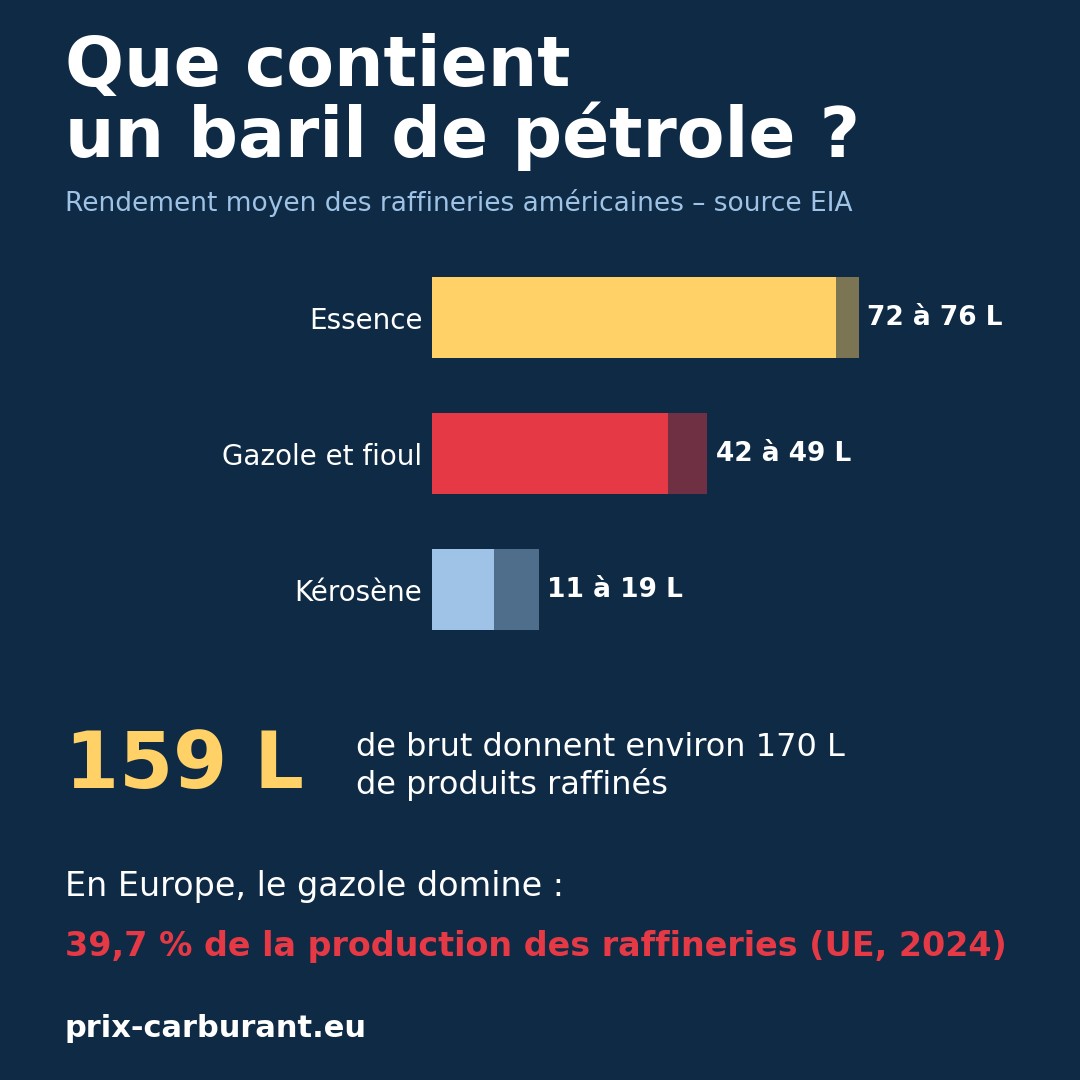
A barrel of crude oil contains 159 litres, but 159 litres of a single fuel do not come out of it. In US refineries, a barrel yields on average 72 to 76 litres of petrol, 42 to 49 litres of distillates, mainly diesel, and 11 to 19 litres of jet fuel, with the rest split between LPG, heavy fuel oil, bitumen and petrochemical feedstocks. In Europe the breakdown is different: diesel is by far the top refinery product, with nearly 40% of their output in 2024.
How a refinery cuts up a barrel
Crude oil is a mixture of hydrocarbons of different sizes. The first refining step is atmospheric distillation: when heated, the crude separates into several “cuts” according to their boiling temperature. This gives:
- light products: gases and petrol;
- middle products, called middle distillates: jet fuel and diesel;
- a heavy cut, the atmospheric residue.
A second step, vacuum distillation, extracts still more distillates from this heavy cut, in order to limit the production of heavy fuel oil. The resulting products then feed conversion processes (coking, visbreaking, hydrocracking, catalytic cracking) that break heavy molecules apart to produce more light fractions, which earn more on the market.
What a barrel yields in the United States
The US Energy Information Administration (EIA) publishes average yields for US refineries. Expressed per 42-gallon barrel, or 159 litres, they give:
| Product | Gallons per barrel | Litres per barrel |
|---|---|---|
| Motor gasoline (petrol) | 19 to 20 | 72 to 76 |
| Distillates (mainly diesel, also heating oil) | 11 to 13 | 42 to 49 |
| Jet fuel (kerosene) | 3 to 5 | 11 to 19 |
| Total refined products | about 45 | about 170 |
More than a dozen other products also come out of refineries, notably liquids used by the petrochemical industry to make plastics and chemicals. The EIA stresses that these volumes vary from month to month, as refiners adjust their output to demand and profitability.
Why a barrel yields more than 159 litres
The total exceeds the starting volume. This phenomenon is called refinery processing gain: most refined products are less dense than the crude they come from, and therefore take up more volume. In 2023, this gain averaged 6.3% in US refineries, which produced about 45 gallons of products for every 42-gallon barrel processed. As a reminder, the barrel remains a unit of volume, as we explain in our article on the capacity of a barrel of oil.
In Europe, a barrel yields mostly diesel
European refineries do not produce the same mix. According to Eurostat, refineries in the European Union produced 543.7 million tonnes of oil equivalent of petroleum products in 2024, with the following breakdown for the main products:
| Product (EU, 2024) | Output (Mtoe) | Share of output |
|---|---|---|
| Diesel and heating oil | 215.7 | 39.7% |
| Motor gasoline (petrol) | 104.3 | 19.2% |
| Heavy fuel oil | 53.1 | 9.8% |
| Naphtha | 41.6 | 7.7% |
In 2025, according to provisional Eurostat data, diesel and petrol together accounted for 59.4% of output from EU refineries. Despite this tilt towards diesel, Europe does not produce enough middle distillates for its consumption: in 2024 it remained a net importer of diesel (15.7 Mtoe), LPG (14.2 Mtoe) and jet fuel (11.0 Mtoe), while exporting petrol on a large scale (43.3 Mtoe of net exports).
Refineries configured differently by region
Comparing major regions shows how much the “content” of a barrel depends on the refinery that processes it. In 2015, according to International Energy Agency data cited by the US Department of Energy, refinery output was split as follows:
| Product (2015) | OECD Americas | OECD Europe | OECD Asia Oceania |
|---|---|---|---|
| Petrol | 41.0% | 20.6% | 18.8% |
| Diesel | 29.2% | 30.7% | 41.0% |
| Jet fuel | 8.2% | 14.9% | 7.7% |
| Naphtha | 1.5% | 12.8% | 6.3% |
| Heavy fuel oil | 4.2% | 8.6% | 11.0% |
| LPG | 2.3% | 2.2% | 2.5% |
| Other products | 13.6% | 10.2% | 12.7% |
US refineries are geared towards petrol, which makes up more than 40% of their output, whereas in Europe petrol accounts for only about a fifth of the total. In 2015, European refineries by contrast produced markedly more jet fuel and naphtha than those in other regions.
Crude quality changes the result too
Not all crude oils are equal. According to the EIA, crudes are classified by density and sulphur content. Light crudes contain more light hydrocarbons: simple distillation is enough to obtain high-value products such as petrol, diesel or jet fuel. Heavy crudes, by contrast, mostly yield low-value products through simple distillation and require additional, more costly treatment. A high sulphur content also complicates refining.
Why this matters for the pump price
A refinery cannot freely decide to produce only the most sought-after fuel. Yet in France, road diesel accounted for 70% of road fuel deliveries in 2025, at 27 million tonnes according to the Comité professionnel du pétrole (CPDP). French refinery output is not enough to cover this demand, which forces France to import a large share of its diesel, as we detail in our article on refineries in France.
This physical link between the products of a single barrel also explains why petrol and diesel do not react in the same way to changes in oil: each depends on the balance between supply and demand for its own cut. We return to this mechanism in our article on the different reactions of fuels to rising oil prices.
Sources
- Refining crude oil – U.S. Energy Information Administration
- How many gallons of gasoline and diesel fuel are made from one barrel of oil? – U.S. Energy Information Administration
- Refining crude oil – inputs and outputs – U.S. Energy Information Administration, updated 20 June 2024
- La chaîne pétrolière – French Ministry of Ecological Transition
- Oil and petroleum products – a statistical overview – Eurostat, August 2026
- Fact #963 : Share of Petroleum Product Output from Refineries Varies by World Region – U.S. Department of Energy, 6 February 2017
- Le marché pétrolier – CPDP