
The Swiss Confederation is studying a temporary 80 km/h speed limit on motorways to cut national fuel consumption, as the country's supply comes under strain. According to 20 Minuten, which relies on information from the Aargauer Zeitung, the Federal Office for National Economic Supply (FONES) has submitted the proposal to several federal administration departments and to the Federal Chancellery. No decision has been taken so far: it is a precautionary measure, being studied in case supply deteriorates.
A proposal under internal consultation
FONES has sent its proposal to other federal administration departments and to the Federal Chancellery. A spokesperson for the office, questioned by the Aargauer Zeitung, confirmed that an internal consultation took place this autumn to prepare for a possible implementation of the measure. The option under consideration is a temporary maximum speed of 80 km/h on Swiss motorways.
Faced with a situation described as "very tense", FONES is therefore examining more radical measures than those already taken. The limit would only be applied if supply difficulties persisted or worsened.
Speed limits currently in force in Switzerland
According to the official portal ch.ch, speed is limited in Switzerland to:
- 120 km/h on motorways;
- 100 km/h on semi-motorways;
- 80 km/h on main roads and secondary roads outside built-up areas;
- 50 km/h in built-up areas.
A temporary 80 km/h limit on motorways would therefore be 40 km/h lower than the current 120 km/h limit, and would bring the maximum speed on motorways in line with that of main roads outside built-up areas.
45 million litres of diesel released from compulsory reserves
On Friday 23 October 2026, the federal authorities decided to release 45 million litres of diesel from compulsory reserves. This volume represents nearly 4% of the stocks built up to deal with supply crises, equivalent to 900,000 fill-ups of 50 litres.
This release is the first concrete response to tensions on the Swiss fuel market. The speed limit would come as a complement: if the shortage worsened, it would help curb national consumption, while the release of reserves would ease supply.
Measures planned before the 80 km/h limit
Lowering the speed limit would not be the first measure applied. According to the measures presented on the FONES website, the Confederation could first call on the public to voluntarily reduce fuel consumption. The recommendations under consideration include:
- greater use of public transport;
- the development of carpooling.
The order adopted at this stage is therefore as follows: first, appeals for voluntary savings, then, if the situation deteriorates, a reduction of the maximum speed on motorways.
How much fuel would an 80 km/h limit save?
This is the point the sources leave open: FONES has not specified the fuel savings such a measure would achieve. No official figure is given, either in litres or as a share of national consumption.
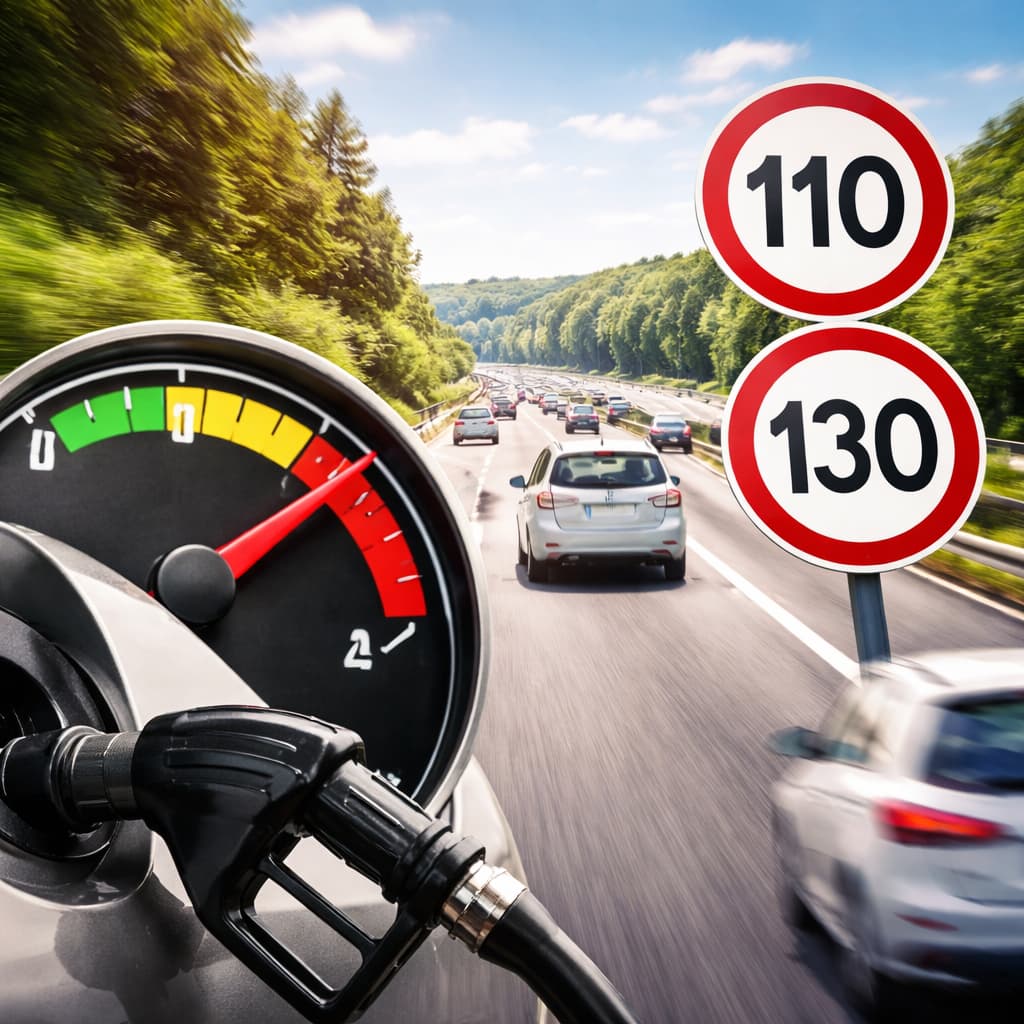
To put the effect of speed on consumption in context, we published a comparison between 110 and 130 km/h in April 2026. It notes that, according to ADEME, driving at 110 km/h instead of 130 km/h represents around 20% fuel savings, and that French road safety authorities mention around 10% savings for every 10 km/h less. These benchmarks concern the move from 130 to 110 km/h: they do not apply as such to an 80 km/h limit. The actual gain also depends on the vehicle, the load, the wind, the terrain and driving style.
Diesel under strain in Europe
Switzerland is not the only country facing diesel tensions. On 2 October 2026, G7 leaders announced the release of up to 100 million barrels of diesel and crude oil over four months, with no export limits or bans between members. The details of this decision are in our article on the G7 emergency stocks.
In the European Union, the pump price of diesel reached a record high with a weekly average of €2.24 per litre (national data compiled by the European Commission, published on 1 October 2026). In addition, 50% of the diesel imported by the EU-27 comes from the United States.
Where does France stand?
In France, the average diesel price stands at €2.362/L on 26 October 2026, based on our readings across 7,108 stations (updated at 9:09 a.m.). The lowest price recorded is €1.25/L and the highest €2.928/L.
In terms of availability, 822 stations are currently reported out of diesel: 332 for less than 24 hours, 325 for 24 to 72 hours and 165 for more than 72 hours. The oldest active shortage dates back to 16 October 2026. Station-by-station tracking is available on our fuel shortage stations page.