
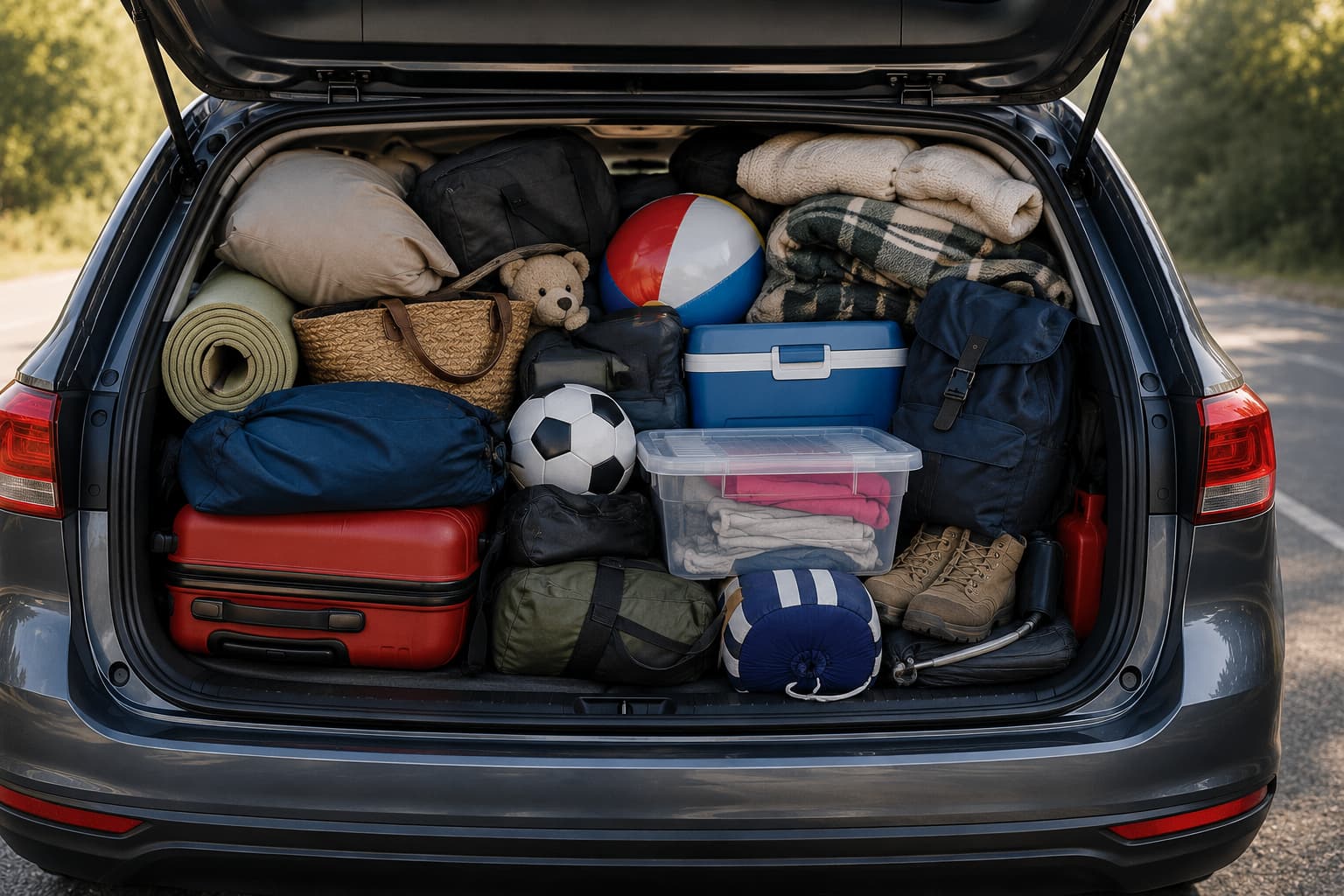
A pack of water forgotten after the shopping, a toolbox, a sports bag: the boot fills up without us noticing, and all that weight travels with you on every trip. According to the various organisations, an extra 100 kg increases fuel consumption by 2% to 7%. The range is wide because the effect depends on the vehicle and the type of journey.
Why weight increases fuel consumption
The heavier a car is, the more energy it takes to get it moving and to overcome tyre rolling resistance. That energy is lost at the next braking, and urban traffic is a constant series of braking. At a steady speed, weight matters much less.
The effect is also stronger on small cars, where the same 100 kg represents a larger share of the total mass. This is what the US Department of Energy and the RAC, the British motoring club, point out.
What the organisations say about 100 kg of load
The estimates vary depending on the methods and the vehicles tested:
- Natural Resources Canada: about 1% more fuel consumption per 25 kg for a mid-size car, i.e. about 4% for 100 kg;
- RAC (United Kingdom): on average 2% per 50 kg, i.e. about 4% for 100 kg;
- US Department of Energy: about 2% for 100 kg;
- ADAC (Germany): up to 0.3 litre per 100 km;
- Test-Achats (Belgium): 6 to 7% for a 100 kg load on a 1,500 kg vehicle in town.
These estimates do not contradict each other: they describe different situations. The effect is strongest in town, with frequent stops and restarts.
Emptying the boot: what can go, what must stay
A pack of six 1.5-litre bottles holds 9 litres of water, so it weighs at least 9 kg. Two forgotten packs already add up to 18 kg. Here is what can come out without regret:
- packs of water and drinks, to be put away as soon as you get home from the shops;
- bags of sand or salt kept after winter;
- tools that are not needed during the journey;
- sports equipment stored there "for now";
- the child seat that no child uses any more.
Some items must stay on board, however: the high-visibility vest and the warning triangle, which are compulsory, and the luggage for a holiday departure, which is not a waste. Whatever stays should be secured so that it does not slide when braking.
And the tank: should you fill it only halfway?
Fuel has weight too: some tips recommend not filling the tank to the brim to lighten the car, and even suggest limiting the fill to 70% of capacity. The available figures show a very small effect.
Researchers at the Australian National University worked out the case of a car using 8 litres per 100 km: about 8.16 L/100 km at the start with a full tank, against about 8.08 L/100 km with a half-full tank. The difference exists, but it is slight.
An almost empty tank, on the other hand, has drawbacks. Futura-Sciences points out that a low fuel level encourages deposits and dirt at the bottom of the tank, which can end up clogging the fuel filter and damaging the injection system. The most effective approach therefore remains to remove what is useless from the boot rather than playing with the fuel level.
Weight loss: the diet that also lightens the car
If an emptied boot saves fuel, why not go further? A family diet also lightens the car, and the more people on board, the more the effect multiplies. Take a family of 5 where everyone loses 4 kilos before the holiday departure: a summer body for everyone, and 20 kilos less in the passenger compartment.
Using the order of magnitude from Natural Resources Canada, i.e. about 1% more fuel consumption per 25 kg, those 20 kilos represent about 0.8% of fuel. On a 50-litre tank, that is a saving of about 40 centilitres, roughly a large cup of coffee.
As for the wallet, the lightening is up to the task: less than one euro saved per fill-up, which does not even pay for a coffee at a motorway service area. The gain is therefore enormous, provided you measure it in cups. To really save fuel, the simplest thing is still to start with the pack of water forgotten in the boot: it weighs at least 9 kg, without any effort of willpower.
The way you drive weighs more than the kilos
Weight makes every acceleration worse, but it is the way you drive that decides how many of them there are. The US Department of Energy estimates that aggressive driving reduces efficiency by 10 to 40% in traffic jams, and by 15 to 30% on the road. These figures far exceed the effect of an overloaded boot.