
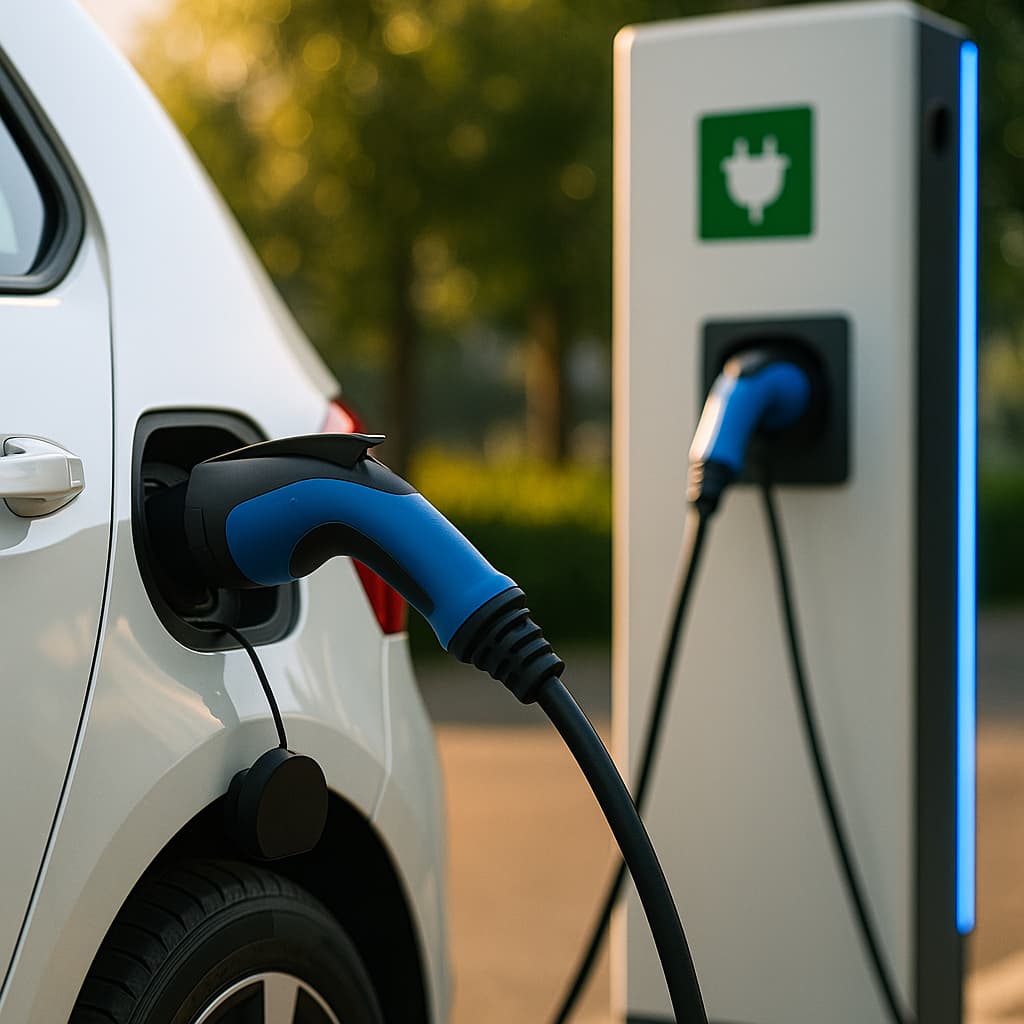
An electric car does not only pay for the energy that ends up in its battery: part of the electricity you pay for is lost during charging, without ever showing up on the on-board computer. According to a study by ADAC, the German automobile club, these losses reach up to 24.2% on a household socket, fall to 5.1 to 7.0% with an 11 kW wallbox and range from 5 to 15% with DC fast charging. The charging method and power therefore weigh heavily on overall efficiency.
The ADAC study: five cars on AC, four on fast charging
The study, published by ADAC on 6 August 2026, measures "phantom kilowatt-hours", meaning energy drawn from the grid that is not available for driving. It has two parts.
- AC charging at home: five models (Mercedes CLA 350 EQ, Renault 5 E-Tech, Tesla Model Y, Volvo EX30 and Volkswagen ID.7), tested on a 2.3 kW household socket (1 x 10 A), on an 11 kW wallbox, on a 22 kW wallbox when the vehicle allows it, and on a 4.1 kW wallbox (3 x 6 A) to simulate solar charging. Measurements cover a charge from 10 to 90% with a battery at 20-30 °C at the start.
- DC charging at a fast-charging station: four models (Hyundai Ioniq 6, Renault Mégane E-Tech, Tesla Model Y and Volkswagen ID.3), 30 kWh charged per vehicle, in three temperature and preconditioning scenarios.
Household socket: from 12.7% to 24.2% losses
The household socket is the least efficient method. At 2.3 kW, the Mercedes CLA 350 EQ loses 24.2% of the electricity drawn, nearly a quarter. The other four models range from 12.7% to 15.3%.
| Model | Household socket 2.3 kW | Solar 4.1 kW | Wallbox 11 kW |
|---|---|---|---|
| Mercedes CLA 350 EQ | 24.2% | 12.8% | 6.9% |
| Renault 5 E-Tech | 13.7% | 8.0% | 5.1% |
| Tesla Model Y | 12.7% | 9.4% | 6.1% |
| Volvo EX30 | 14.2% | 9.1% | 7.0% |
| Volkswagen ID.7 | 15.3% | 10.6% | 6.9% |
For the Mercedes, ADAC states that the on-board charger charges at 8 A instead of 10 A, which would explain its high losses on a household socket.
Wallbox: from 5.1% to 7.0% losses
On an 11 kW wallbox, losses fall to 5.1% for the Renault 5 E-Tech and 7.0% for the Volvo EX30, the lowest range among AC charging methods. Only the Volvo EX30 accepts the 22 kW wallbox in the study: it shows 6.7%. ADAC recommends charging on a wallbox rather than a household socket, which roughly halves the losses, and charging at maximum AC power to shorten the charge.
Solar charging at 4.1 kW: from 8.0% to 12.8%
To simulate a photovoltaic installation, ADAC used a wallbox limited to 4.1 kW. Losses range from 8.0% (Renault 5 E-Tech) to 12.8% (Mercedes CLA 350 EQ). Slow charging therefore remains more costly in losses than charging at 11 kW.
DC fast charging: from 5 to 15% total losses
With fast charging, the conversion from alternating to direct current takes place in the charging station rather than in the car. According to ADAC, "all things considered", energy losses with DC charging amount to 5 to 15%. Conversion in the station accounts for an average of 3%, and battery heating adds 2 to 8% of losses. ADAC's table, titled "charging losses in the vehicle", gives the following values.
| Model | Preconditioning, 23 °C | Preconditioning, 0 °C | No preconditioning, 0 °C |
|---|---|---|---|
| Hyundai Ioniq 6 | 1% | 1% | 6% |
| Renault Mégane E-Tech | 4% | 6% | 8% |
| Tesla Model Y | 3% | 4% | 10% |
| Volkswagen ID.3 | 3% | 5% | 7% |
For every model, the biggest gap appears between a preconditioned battery and a cold battery without preconditioning: the Tesla Model Y goes from 3% to 10%. ADAC specifies that the Renault Mégane E-Tech and the Volkswagen ID.3 have no active battery conditioning. The article does not explain how this table relates to the overall 5 to 15% range.
Where do the losses come from?
ADAC identifies several sources of losses depending on the charging method.
- Household socket: the on-board charger converts alternating current to direct current, which generates significant losses. The 12 V on-board network draws 100 to 300 W for the control units, which penalises slow charging. A long supply line can also play a part: the German standard DIN VDE 0100 tolerates up to 4% losses in the installation.
- Wallbox: three-phase and more heavily wired, it reduces line losses and auxiliary consumption, because charging is faster. Conversion in the on-board charger remains.
- DC charging: conversion takes place in the station. The main losses come from battery cooling and above all from heating a cold battery.
ADAC's advice to limit losses
- Charge on a wallbox rather than a household socket, which also improves safety.
- Charge at maximum power on AC.
- Have the home electrical installation checked by an electrician, especially if it is old.
- Preheating the battery while driving saves time, but not energy.
- On DC, reducing the charging power on the vehicle side can limit losses, but lengthens the charging time.
ADAC does not put a euro figure on these losses and quotes no price per kWh. It only says that the higher cost of electricity at public DC charging cannot be offset by its better efficiency. To understand the difference between the two modes, read our article on AC and DC charging, and on price gaps, why the price of an electric charge can double at the same station. To find a charging point near you, the map of charging stations is available on the site.