
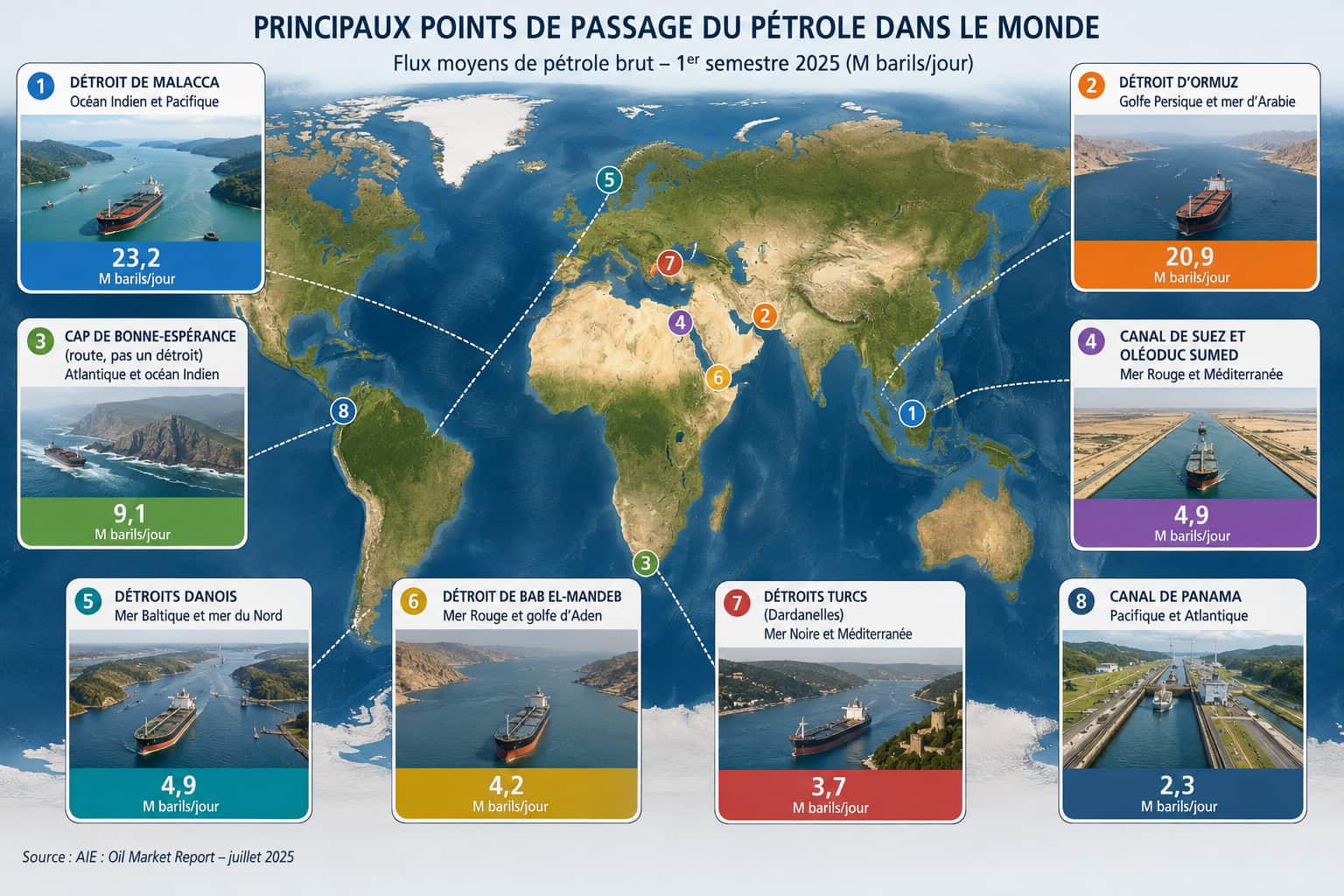
Around 80 million barrels of oil travel by sea every day, and a large share passes through a handful of narrow passages called chokepoints. The Strait of Hormuz is the most sensitive of them: before the 2026 war, 20.9 million barrels a day passed through it, a quarter of the oil transported by sea and the equivalent of 20% of world consumption. In the second quarter of 2026, only 4.9 million still did, according to the US Energy Information Administration (EIA). This near-closure caused the largest oil supply disruption in history, according to the International Energy Agency (IEA).
What is an oil chokepoint?
A chokepoint is a narrow channel on a major shipping route through which large volumes of oil and liquefied natural gas transit. According to the EIA, the blockage of one of these passages, even temporary, can cause major supply delays and raise transport costs, which feeds through to energy prices worldwide.
Most of these passages can be bypassed, but at the cost of much longer journeys. Some have no realistic alternative at scale.
The main passages for world oil
In the first half of 2025, world oil supply reached 104.4 million barrels per day, of which about 76% (79.8 million) travelled by sea. The EIA tracks seven chokepoints, as well as the Cape of Good Hope route. The comparison with the second quarter of 2026 shows the scale of the upheaval caused by the war:
| Passage | Connects | H1 2025 (M barrels/day) | Q2 2026 (M barrels/day) |
|---|---|---|---|
| Strait of Malacca | Indian and Pacific Oceans | 23.2 | 16.6 |
| Strait of Hormuz | Persian Gulf and Arabian Sea | 20.9 | 4.9 |
| Cape of Good Hope (a route, not a strait) | Atlantic and Indian Oceans | 9.1 | 9.4 |
| Suez Canal and SUMED pipeline | Red Sea and Mediterranean | 4.9 | 5.8 |
| Danish Straits | Baltic Sea and North Sea | 4.9 | 4.7 |
| Bab el-Mandeb Strait | Red Sea and Gulf of Aden | 4.2 | 8.1 |
| Turkish Straits (Dardanelles) | Black Sea and Mediterranean | 3.7 | 4.1 |
| Panama Canal | Pacific and Atlantic | 2.3 | 3.2 |
Hormuz, the most critical passage
Located between Iran and Oman, the Strait of Hormuz links the Persian Gulf to the Gulf of Oman and the Arabian Sea. It is deep enough and wide enough to accommodate the world’s largest tankers. In the first half of 2025, 14.7 million barrels per day of crude oil and 6.1 million barrels per day of petroleum products (diesel, jet fuel, petrol…) passed through it. More than 20% of world liquefied natural gas trade also uses it, mainly from Qatar.
Most of this oil goes to Asia: 89% of the crude transiting Hormuz was destined for Asian markets in the first half of 2025, with China, India, Japan and South Korea alone absorbing 74%.
What makes Hormuz so critical is the weakness of the alternatives. Before the war, the EIA estimated that Saudi Aramco’s East-West pipeline and the Abu Dhabi pipeline could together bypass the strait for about 4.7 million barrels per day, less than a quarter of usual volumes. The Iranian Goreh-Jask pipeline offers an effective capacity of only about 0.3 million barrels per day.
2026: a strait almost closed
A few days after the start of the US and Israeli strikes on Iran, on 28 February 2026, Iranian forces declared the strait closed. Traffic almost stopped, leaving hundreds of ships stranded in the Persian Gulf. According to the EIA, flows of oil and petroleum products through Hormuz fell from 21.6 million barrels per day in the fourth quarter of 2025 to 14.9 million in the first quarter of 2026, then to 4.9 million in the second quarter: 3.7 million of crude and only 1.1 million of refined products. Liquefied natural gas almost stopped, at 0.8 billion cubic feet per day against 10.5 at the end of 2025. World oil supply fell from 108.2 million barrels per day in the third quarter of 2025 to 96.1 million in the first quarter of 2026.
The situation then alternated between lulls and renewed hostilities, according to the US Congressional Research Service (CRS):
| Date | Event |
|---|---|
| 7 April 2026 | Ceasefire between the United States and Iran. A few ships cross, then Iran interrupts traffic again. |
| 13 April 2026 | The United States imposes a blockade of Iranian ports. |
| May 2026 | Iran creates a “Persian Gulf Strait Authority” and requires a transit permit for every ship. |
| 17 June 2026 | US–Iran memorandum of understanding: blockade lifted and commercial ships allowed through free of charge for 60 days. |
| July 2026 | Resumption of Iranian attacks on ships, US blockade reinstated. |
Iran now claims control of the entire strait, even though it also crosses Omani territorial waters. At 22 nautical miles (about 40 km) wide at its narrowest point, it offers no alternative sea route.
Traffic that is hard to measure
The volume actually passing through the strait is the subject of a war of numbers. On 3 September, Donald Trump claimed that 18 million barrels per day were again transiting Hormuz. Maritime tracking firms are far more cautious: according to Kpler, outflows stayed below 5 million barrels per day in the week of 30 August, and Vortexa recorded only two days above 16 million since March. The US Energy Secretary, for his part, cited on 6 September a seven-day average of 9 million barrels per day. Most tankers now cross at night, transponders switched off, which complicates any count. The EIA itself acknowledges that ship positioning signals in the strait have become particularly unreliable since late February 2026, and that its data are frequently revised.
The risk also shows in insurance: the premium to cross the strait exceeds 10% of a ship’s value, against 0.25% on average before the war.
Bypass routes themselves targeted
To compensate, Saudi Arabia has massively shifted its exports to the Red Sea. With a capacity of 7 million barrels per day, its East-West pipeline links Abqaiq, near the Gulf, to the port of Yanbu. According to the IEA, loadings from Yanbu rose from about 2 million barrels per day before the conflict to more than 5 million in early June. The United Arab Emirates, for their part, rerouted about 1 million barrels per day to the port of Fujairah, on the Arabian Sea.
On 10 September 2026, drone attacks launched from Iraq led to the shutdown of the East-West pipeline, which was still carrying about 4 million barrels per day. Yanbu’s tanks made it possible to maintain loadings for five to seven days, according to industry sources cited by Reuters. Saudi Arabia’s production reported to OPEC had already fallen to 6.2 million barrels per day in August, against 10.9 million in February. Immediately afterwards, Riyadh resumed selling crude shipped through Hormuz: about 20 million barrels were sold to Asian refineries in the week of 16 September.
In total, according to the IEA, Gulf countries’ oil exports were about 13 million barrels per day in August, close to half their pre-war level. More than 10 million barrels per day of production remained shut in, and the agency no longer expects a return to normal before 2027.
Bab el-Mandeb and Suez: the Red Sea already disrupted
The Bab el-Mandeb Strait, between the Horn of Africa and Yemen, and the Suez Canal are the natural routes for Gulf oil to Europe. Since the attacks on commercial ships by Yemen’s Houthi rebels beginning in November 2023, some tankers have chosen to go around Africa via the Cape of Good Hope. As a result, volumes passing through Bab el-Mandeb fell from 9.3 million barrels per day in 2023 to 4.2 million in the first half of 2025, while those going around the Cape rose from 6.2 to 9.1 million. The trend reversed in 2026: in the second quarter, 8.1 million barrels per day crossed Bab el-Mandeb, including 6.1 million of crude, as Saudi Arabia routed a growing share of its exports through its Red Sea ports.
This detour has a cost: according to the EIA, a closure of the Suez Canal and the SUMED pipeline would force tankers to add about 15 days of travel between the Arabian Sea and Europe. In July 2026, the Houthis also announced a maritime blockade against Saudi Arabia and attacked Saudi tankers in the Red Sea. On 11 September, they took control of the Yemeni Red Sea coast and the islands of the Bab el-Mandeb Strait, claiming that navigation there remained safe for everyone except Saudi Arabia. The route used to bypass Hormuz is thus itself under pressure.
Malacca, Danish Straits, Bosphorus, Panama
The other chokepoints weigh less directly on French supply, but they structure the world market:
- The Strait of Malacca, between Malaysia and Indonesia, is the world’s largest chokepoint by volume, with 29% of seaborne oil flows. It mainly carries Middle Eastern crude to East Asia. Deprived of part of the Gulf cargoes, its traffic fell from 24.9 million barrels per day at the end of 2025 to 16.6 million in the second quarter of 2026.
- The Danish Straits, linking the Baltic to the North Sea, see 4.9 million barrels per day pass, mostly Russian exports now directed to Asia and Turkey.
- The Turkish Straits (Bosphorus and Dardanelles) carry Russian and Caspian oil. Narrower than half a nautical mile at its narrowest point, about 900 metres, the passage is among the hardest in the world to navigate.
- The Panama Canal mainly carries refined products (2.2 million barrels per day out of 2.3), as crude tankers are often too large to use it.
Why diesel is more exposed than petrol
The crisis hits refined products first. According to the IEA, losses of Gulf crude exports have been brought down to a little under 45% thanks to bypass routes and US military escorts. But exports of refined products and LPG were still almost 60% below their February level in August, i.e. 3.7 million barrels per day less.
Diesel is the hardest hit. Net diesel exports from Gulf countries fell to 390,000 barrels per day in August, a little over a quarter of their pre-war level. Ukrainian attacks on Russian refineries have worsened the shortfall: together, the Gulf and Russia, which accounted for nearly 45% of world seaborne diesel trade in February, exported 1.6 million barrels per day less in August. In early September, diesel exceeded $200 a barrel in the United States, 94% more than before the war, and exceeded $198 in Europe.
France is particularly concerned. In 2024, only 12% of imported crude came from the Middle East, against 33% of imported road diesel and 61% of jet fuel, these shares indicating the origin of the products without specifying which of them transited through Hormuz. According to the Service des données et études statistiques, transport accounts for nearly two-thirds of French consumption of refined petroleum products, and road fuels alone for 61%. This exposure also explains why, as we detailed in our article on the different reactions of fuels to the rise in oil, diesel does not always follow the same path as petrol.
At this stage, the crisis remains a price crisis more than a physical supply crisis: on 8 September, the European Union’s Oil Coordination Group saw no immediate problem, while flagging particularly tight markets for diesel and jet fuel. This assessment predates the shutdown of the Saudi pipeline.
What this changes at the pump
In early September, Brent traded around $105 a barrel, 45% above its pre-war level according to the IEA. Since February, observed global oil stocks have fallen by 507 million barrels. The record release of 400 million barrels decided by the IEA on 11 March covered only about 20 days of usual Hormuz traffic, as we explain in our article on strategic oil stocks. To follow the barrel day by day, see our page on the Brent price.
Sources
- World Oil Transit Chokepoints (updated 3 March 2026) – U.S. Energy Information Administration
- Oil Market Report – September 2026 – International Energy Agency, 11 September 2026
- Update on IEA collective action decision of 11 March 2026 – International Energy Agency, 15 March 2026
- Global Energy Security Data – U.S. Energy Information Administration, 12 August 2026
- The Strait of Hormuz: Security Developments and Impacts on Oil, Gas, and Other Commodities – Congressional Research Service, 7 August 2026
- Après des attaques de drones venus d’Irak, l’Arabie saoudite ferme l’oléoduc Est-Ouest – France 24, 12 September 2026
- Détroit d’Ormuz : le trafic est-il vraiment redevenu normal ? – L’essentiel, 19 September 2026
- Ormuz : le point faible français n’est pas le brut – La Clé publique, 7 September 2026
- Essence et gazole : Macron envisage de rouvrir les stocks de pétrole, mais les prix peuvent-ils baisser ? – Selectra, 22 September 2026