
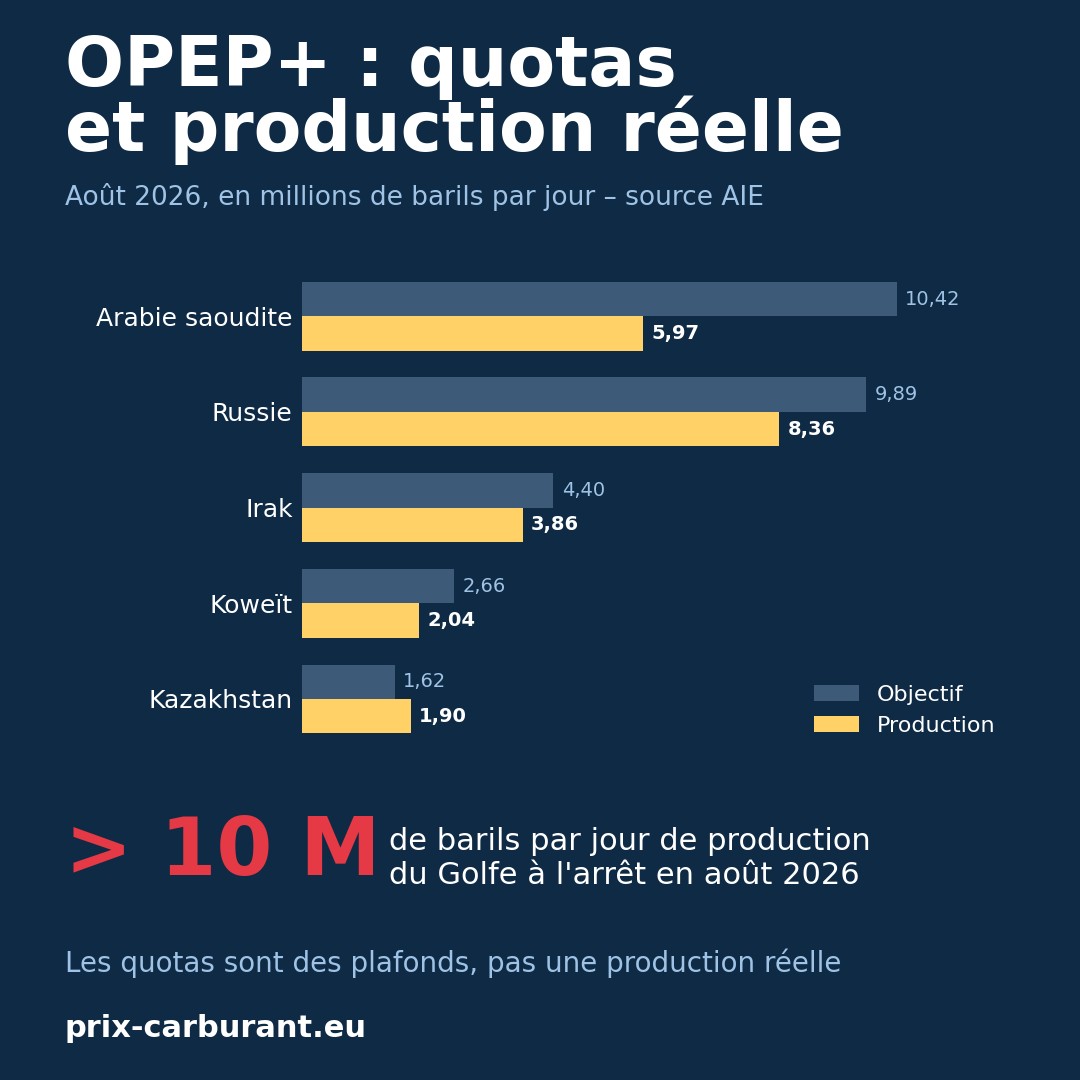
OPEC+ is the alliance that brings together the member countries of the Organization of the Petroleum Exporting Countries (OPEC) and other major producers led by Russia, 21 countries since the United Arab Emirates left on 1 May 2026. Each month it sets production quotas, meaning ceilings, not actual output. Its influence on the pump price runs through the cost of oil, which in mid-September 2026 accounted for only 42.2% of the price of a litre of SP95-E10 and 48.6% of diesel. In 2026, the war in the Middle East in fact weighs far more on prices than the cartel's quotas.
OPEC and OPEC+: who belongs?
OPEC was founded in Baghdad in September 1960. OPEC+ extends the organization to non-member producers, including Russia, which coordinate their production policy with it. According to the International Energy Agency (IEA) report of September 2026, the alliance is made up as follows:
| Group | Countries |
|---|---|
| OPEC members subject to quotas | Algeria, Saudi Arabia, Congo, Gabon, Equatorial Guinea, Iraq, Kuwait, Nigeria |
| OPEC members exempt from quotas | Iran, Libya, Venezuela |
| Non-OPEC associated countries | Russia, Kazakhstan, Azerbaijan, Oman, Mexico, Bahrain, Brunei, Malaysia, Sudan, South Sudan |
The membership changed in 2026. The United Arab Emirates announced on 28 April that they were leaving OPEC and OPEC+, effective 1 May, after 59 years of membership. Their quota capped them at 3.2 million barrels per day, well below their capacity of 4.85 million, a long-standing disagreement with Saudi Arabia. According to France Épargne, this departure takes OPEC's share of world production below 30% for the first time in its history.
How OPEC+ quotas work
A quota is a right to produce, not an obligation. Raising a quota allows a country to produce more, but says nothing about its real ability to do so. In 2026, OPEC+ layers two levels of restriction:
- collective cuts, which apply to most members until 31 December 2026, a deadline confirmed at the 40th ministerial meeting in November 2025;
- voluntary cuts, agreed in April and November 2023 by a small group of countries, which have been lifting them gradually since.
This small group now has seven countries: Saudi Arabia, Russia, Iraq, Kuwait, Kazakhstan, Algeria and Oman. They meet every month to adjust their targets. Part of the announced volumes also serves to compensate for past overproduction, as some countries produced above their quotas.
2026: quota increases, then a pause
On 2 August 2026, the seven countries decided on an increase of 188,000 barrels per day for September, in line with previous months. The September quotas were distributed as follows:
| Country | Increase (barrels/day) | September 2026 quota (million barrels/day) |
|---|---|---|
| Saudi Arabia | +62,000 | 10.478 |
| Russia | +62,000 | 9.949 |
| Iraq | +26,000 | 4.431 |
| Kuwait | +16,000 | 2.676 |
| Kazakhstan | +10,000 | 1.628 |
| Algeria | +6,000 | 1.007 |
| Oman | +5,000 | 0.841 |
This increase completed the unwinding of the 1.65 million barrels per day of voluntary cuts decided in 2023. Meeting by videoconference on 6 September 2026, the seven countries then decided, according to the OPEC statement, to keep the September required production level for October, ending six consecutive months of increases. They reaffirmed their commitment to fully comply with the Declaration of Cooperation, the founding text of OPEC+, and set their next meeting for 4 October 2026. The group is now preparing the definition of the 2027 quotas, assessing each country's maximum capacity.
Quotas disconnected from actual output
In 2026, quotas carry little weight against the physical situation of the market. According to the IEA, more than 10 million barrels per day of Gulf production remained shut in during August because of security risks linked to the war and the near-blockage of the Strait of Hormuz. The gap between targets and output is striking:
| Country (August 2026) | Output (million barrels/day) | Implied target (million barrels/day) |
|---|---|---|
| Saudi Arabia | 5.97 | 10.42 |
| Russia | 8.36 | 9.89 |
| Iraq | 3.86 | 4.40 |
| Kuwait | 2.04 | 2.66 |
| Kazakhstan | 1.90 | 1.62 |
Saudi Arabia, the cartel's cornerstone, thus produced 4.45 million barrels per day less than its target. Among these countries, only Kazakhstan exceeded its own. The IEA put the available production capacity that could actually be mobilized within OPEC+ at just 0.22 million barrels per day. In this context, a quota increase is only worth something if the extra barrels can actually be extracted, loaded and shipped. To understand this blockage, read our article on the Strait of Hormuz and oil chokepoints.
What is the real effect on the pump price?
OPEC+ decisions act on only part of the price paid at the pump: the cost of the refined product, which depends on the price of crude oil. The rest is made up of taxes and distribution costs that do not depend on the cartel. On 15 September 2026, according to our breakdown of the price of fuels, a litre was made up as follows:
| Component | SP95-E10 (€2.140) | Diesel (€2.351) |
|---|---|---|
| Refined product price | €0.903 (42.2%) | €1.142 (48.6%) |
| Distribution | €0.12 (5.6%) | €0.12 (5.1%) |
| Energy savings certificates | €0.09 (4.2%) | €0.09 (3.8%) |
| Excise duty | €0.6702 (31.3%) | €0.6075 (25.8%) |
| VAT | €0.357 (16.7%) | €0.392 (16.7%) |
Because excise duty is a fixed amount per litre, a change in the crude price is only partly passed through at the pump. Our simulation shows that a barrel falling from 85 to 40 dollars would bring SP95-E10 down from about €1.70 to €1.37 per litre, far less than the fall in the barrel.
The 2026 crisis also illustrates that the pump price depends on the market for refined products as much as on crude. According to the IEA, in early September Brent traded around 105 dollars a barrel, 45% above its pre-war level, while diesel exceeded 200 dollars a barrel in the United States, 94% above its pre-war level. OPEC+ quotas apply to crude oil and have no direct hold on this diesel-specific imbalance. To follow the barrel, see our page on the Brent price.
Sources
- Saudi Arabia, Russia, Iraq, Kuwait, Kazakhstan, Algeria, and Oman reaffirm commitment to market stability – OPEC, press release of 6 September 2026
- Oil Market Report – September 2026 – International Energy Agency, 11 September 2026
- Retrait de l'OPEP : le pari risqué des Émirats arabes unis – IRIS, 4 May 2026
- EAU quittent l'OPEP 2026 : impact pétrole investisseurs – France Épargne, 2 May 2026