
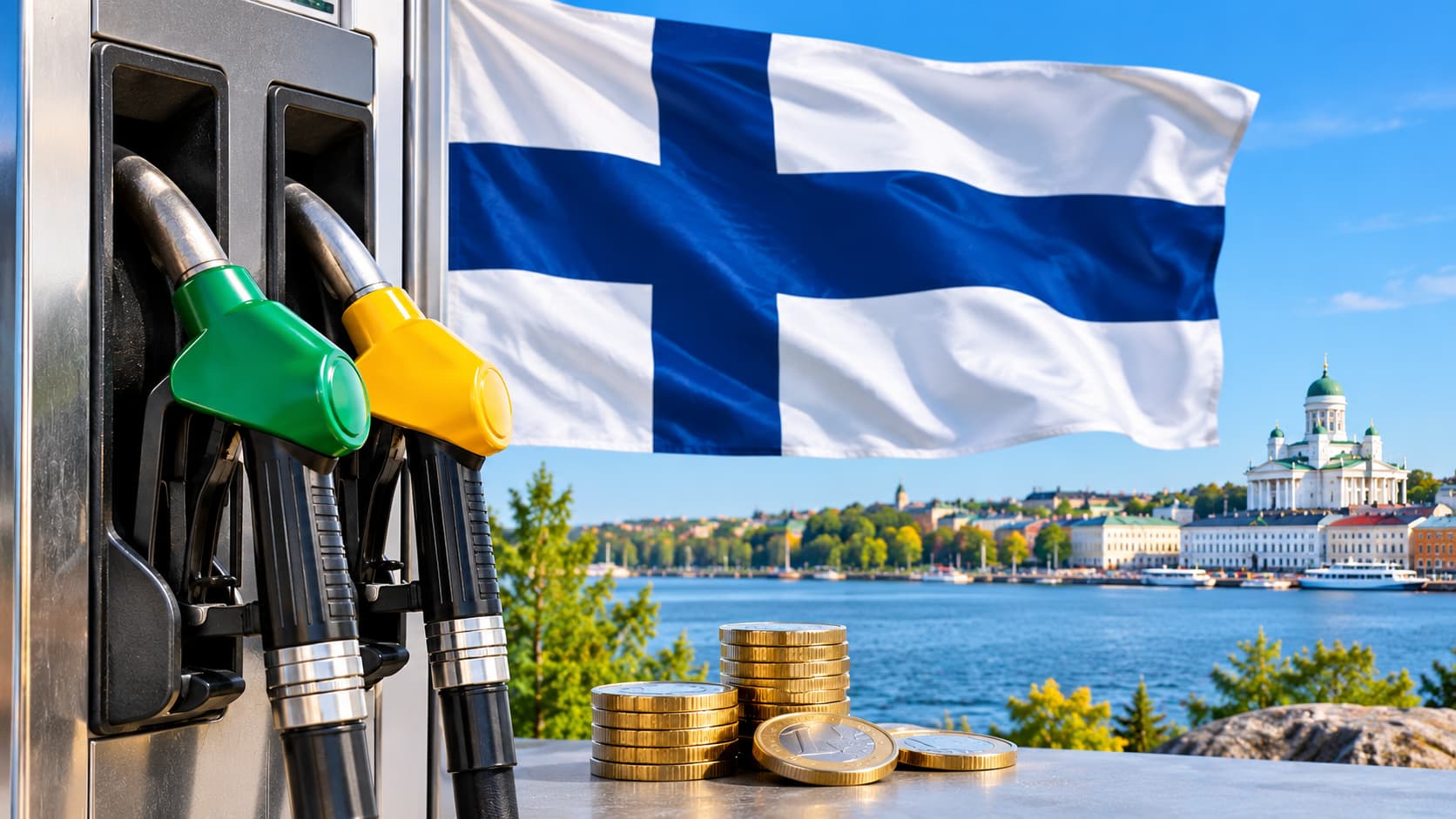
On 15 October 2026, the Finnish government announced a €60 million support package in response to rising fuel prices. It contains no cut in diesel excise duty, and the government has not lowered the distribution obligation for renewable fuels, which the Finns Party (Perussuomalaiset) had called for. The measures are not expected to lower pump prices directly.
What the €60 million package contains
According to the public broadcaster Yle, the package is financed within the State's spending limits: €40 million comes from a biogenic carbon capture appropriation not used this year, and €20 million from a cut in basic transport infrastructure management funding. It comprises three measures:
- €30 million of fuel support for businesses in transport, agriculture and forestry. The precise allocation remains to be defined during the preparatory work;
- €20 million for the reduction of the basic vehicle tax, compared with €10 million decided at the spring budget session;
- €10 million for raising the ceiling on the commuting expense deduction, from €7,000 to €7,800 in 2027.
The vehicle tax reduction appears on the tax bill, not at the pump. Yle puts it at about €12 a year per motorist concerned and states that it applies only to older vehicles.
The distribution obligation kept, with more flexibility
The distribution obligation (jakeluvelvoite) sets the share of renewable fuels that distributors must place on the market. The Finns Party wanted it reduced to bring prices down. The government kept its level but raised the cross-compensation and over-compliance ceilings from 30% to 100%, so that suppliers can meet it at lower cost.
Prime Minister Petteri Orpo said that easing the obligation would not have lowered prices quickly. He attributes the increase to the situation in the Strait of Hormuz and to Russia's war in Ukraine. The Finns Party, through Jani Mäkelä, considers the package insufficient but accepted it.
The reactions of the organisations
The Confederation of Finnish Industries (EK) welcomed the retention of the obligation. Hanna Kalenoja of the Central Chamber of Commerce regrets the absence of a diesel excise cut; the Chamber had also proposed introducing a professional diesel (ammattidiesel). Anssi Kujala, managing director of the road transport organisation SKAL, calls the solution adopted "passable", calls for very rapid preparation of the fuel support and asks for a reconsideration of lowering the obligation, since the flexibilities granted would have a limited effect.
Excise duty on petrol and diesel
According to government proposal 266/2026, excise duty on fossil road fuels (energy, CO₂ and security of supply fee) is 70.18 c/l for petrol and 53.30 c/l for diesel from 1 April to 31 December 2026. It falls to 68.64 c/l and 51.54 c/l from 1 January 2027. Parliament had already approved a reduction in road fuel taxation on 1 January 2026; the proposal estimated it at about €50 million of lost revenue for 2026.
A refund for professional diesel, not before 2028
Proposal 266/2026, submitted to Parliament on 22 October 2026 and not yet adopted, provides for a refund of 3.3 c/l of excise duty on diesel used for professional purposes. It would cover coaches and goods vehicles of at least 7.5 tonnes, with a minimum of €330 per claim. Its entry into force is linked to the European emissions trading system for fuels, probably on 1 January 2028, and it would run until 31 December 2037.
The prices recorded by the Commission
According to the European Commission's oil bulletin, which we publish on our Europe fuel prices page, updated on 16 November 2026, diesel is at €2.564 per litre in Finland, the highest price of the 27 countries, against €2.050 on average in the European Union, i.e. 51.4 cents more. Euro-super 95 is at €2.201 per litre, the second highest price behind Denmark (€2.364), and 37.2 cents above the European average (€1.829).
In Finland, diesel is therefore 36.3 cents more expensive than petrol, even though its excise duty is 16.88 cents lower. Among the Baltic Sea neighbours, diesel is at €1.910 per litre in Sweden and €2.045 in Estonia; petrol is at €1.408 and €1.751. For Sweden, which chose to cut its taxes, you can read our (French-language) article on the temporary cut in fuel taxes in Sweden, and for a broader comparison our (French-language) overview of how European countries are reacting.