
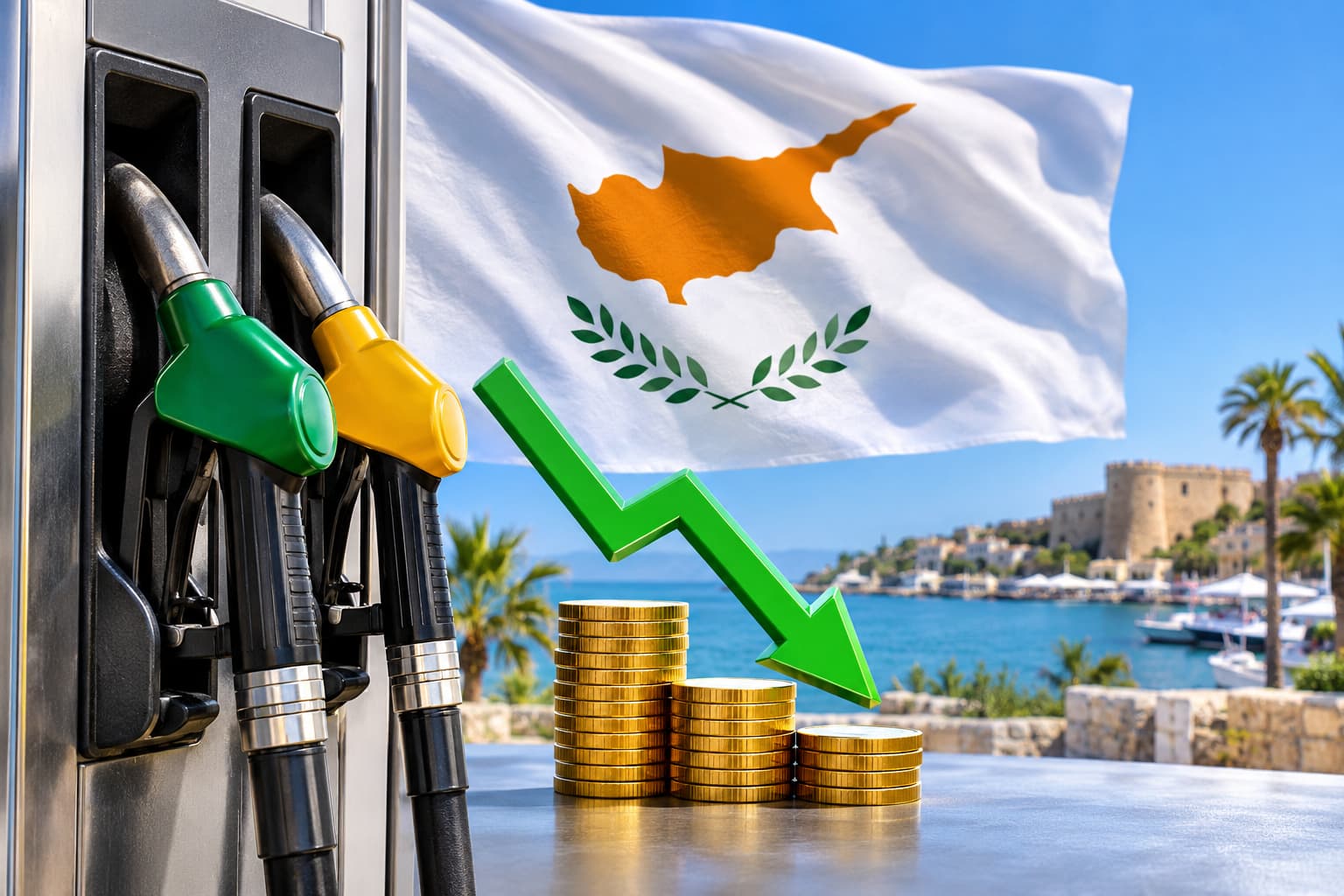
In Cyprus, the State has cut the excise duty on petrol and diesel by 8.33 cents per litre, VAT included. The cut has applied without interruption since 4 April 2026 and runs until 30 November 2026; on 4 November, the Finance Minister announced that he would ask the Council of Ministers to renew it, possibly until March 2027.
The reduced excise rates
For motor fuels, the reduction brings excise duty down from €0.429 to €0.359 per litre for unleaded petrol and from €0.40 to €0.33 per litre for diesel. The difference is €70 per 1,000 litres, i.e. 7 cents per litre; with 19% VAT, it amounts to 8.33 cents per litre (€0.07 × 1.19), with the pre-tax price unchanged.
The Cypriot government says it has brought these taxes down to the lowest level allowed by European rules. Finance Ministry officials also said so before the House Energy Committee, adding that excise duty represents more than 50% of fuel taxation.
Three successive laws since April 2026
The reduction has been extended several times, each time by a law passed before the deadline:
- Law 46(I)/2026: from 4 April to 30 June 2026, as part of a package of measures announced in March 2026;
- Law 120(I)/2026: from 1 July to 17 September 2026;
- Law 125(I)/2026: from 18 September to 30 November 2026, published in Official Gazette no. 5096 of 17 September 2026.
The Council of Ministers approved the latest extension on 10 September 2026, on a proposal from the Finance Ministry. The ministry put the cost of the July-August 2026 extension at €12 million.
One measure among others
The excise cut is part of a set of measures against the rising cost of living announced in March. It also includes the decision not to apply the "green tax" on fuels, which would have added 9 cents per litre. For electricity, VAT is reduced to 5% (from 9%) from 1 May 2026 to 31 March 2027.
On 30 September 2026, the Council of Ministers approved another €70 million package comprising seven measures. Among them, the excise duty on heating oil goes from 7.4 to 2.1 cents per litre from 1 November, the minimum allowed by the European Commission. Cyprus has asked Brussels for a derogation to reduce it further, and the minister said on 4 November that he was awaiting the response of the Commission's services.
What changes if the cut is not renewed
On 1 December 2026, without a new law, the normal rates of €0.429 per litre (petrol) and €0.40 per litre (diesel) would apply again. With the pre-tax price unchanged, the increase would be 8.33 cents per litre, VAT included. At the time of writing, we have not found a law or a Council of Ministers decision extending the measure beyond 30 November.
How the cut is passed on at the pump
The Consumer Protection Service, which comes under the Ministry of Energy, Commerce and Industry, runs a fuel price observatory and tracks changes daily. Its director, Constantinos Karagiorgis, said it would make recommendations to the minister in the event of an unjustified increase.
When the reduction took effect on 4 April 2026, the Service recorded an average fall of 7.9 cents per litre for 95 petrol between 8 pm on 3 April and 10:30 am on 4 April. The head of the Consumers Association, Marios Drousiotis, claimed on the contrary that a large number of stations had not applied the cut in full.
The prices recorded by the Commission
According to the European Commission's oil bulletin, which we publish on our Europe fuel prices page, updated on 16 November 2026, diesel is at €1.986 per litre in Cyprus and SP95 petrol at €1.625 per litre. These prices are lower than those of Greece (€2.038 per litre for diesel, €1.969 per litre for SP95), by 5.2 cents for diesel and 34.4 cents for SP95. They are higher than those of Malta (€1.210 and €1.340 per litre), by 77.6 cents for diesel and 28.5 cents for SP95.
The Cypriot Consumer Protection Service compares the increases since the start of the crisis: between the bulletin of 23 February 2026 and the average of the bulletins of 3, 10 and 17 August, SP95 rose by 27 cents per litre in Cyprus, against 29 cents on average in the European Union. To compare with the other countries that have acted on prices or taxes, you can read our (French-language) overview of how European countries are reacting.