

On 19 October 2026, diesel costs an average of €2.139 per litre in the European Union and SP95 petrol €1.991 per litre, according to the European Commission's Weekly Oil Bulletin. Both fuels remain well below their 28 September peaks (€2.237 for diesel, €2.104 for SP95), but the downward move has stopped: diesel gains 0.3 cent over the week, while SP95 falls by 1.9 cents. Several public measures, adopted or expired in early October, help explain these gaps.
EU average: a decline since the 28 September peak
The average price of diesel went from €2.237 per litre on 28 September to €2.149 on 5 October, then €2.136 on 12 October and €2.139 on 19 October, nearly 10 cents below the peak. SP95 follows a similar path: €2.104 on 28 September and €1.991 on 19 October, 11.3 cents lower. LPG stands apart at €1.740 per litre (+0.8 cent over the week).
Out of 27 countries, thirteen show a higher diesel price than a week earlier, ten a lower one and four (Croatia, Denmark, Spain and Malta) are unchanged. For SP95, falls dominate: fifteen countries are down, ten are up and two are unchanged (Cyprus and Malta).
Diesel: Estonia leads the rises, Austria the falls
The biggest weekly rise in diesel is in Estonia (+4.9 cents, to €2.062), ahead of Luxembourg (+3.6 cents), Slovakia (+3.3 cents), Czechia (+3.2 cents) and Portugal (+2.7 cents). On the downside, Austria loses 3.0 cents (€2.132), Ireland 2.7 cents, the Netherlands 2.6 cents and Slovenia 2.5 cents.
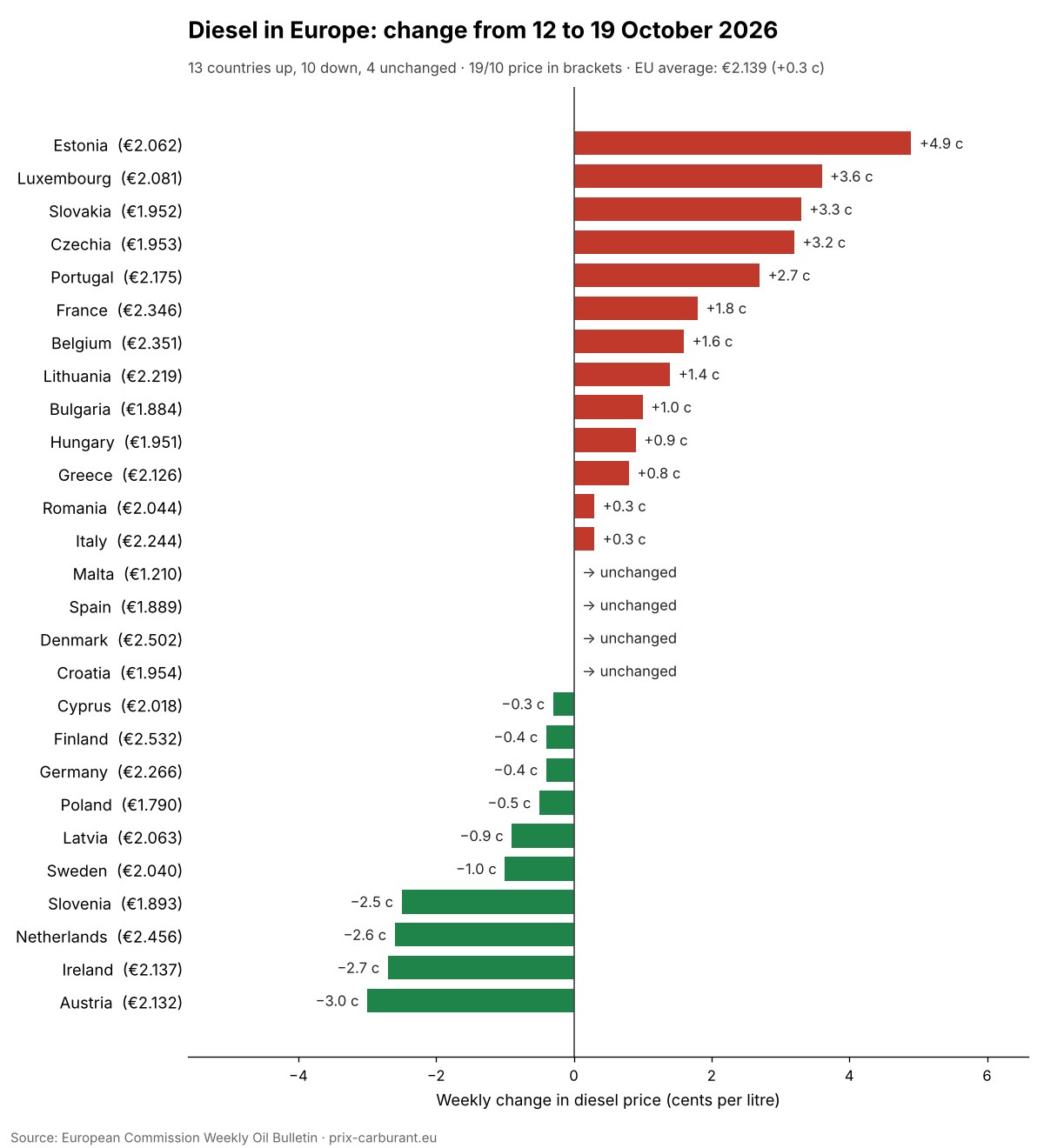
The price ranking is stable. The five cheapest diesel prices are in Malta (€1.210), Poland (€1.790), Bulgaria (€1.884), Spain (€1.889) and Slovenia (€1.893). The five most expensive are in Finland (€2.532), Denmark (€2.502), the Netherlands (€2.456), Belgium (€2.351) and France (€2.346).
SP95: Luxembourg and the Netherlands fall sharply
For petrol, Luxembourg records the biggest drop of the week (−8.8 cents, to €1.788), ahead of the Netherlands (−7.1 cents, to €2.391), Denmark (−5.3 cents), Sweden (−5.2 cents) and Austria (−4.8 cents). Conversely, Slovakia (+3.9 cents), Estonia (+3.4 cents) and Lithuania (+2.6 cents) show the clearest increases.
Denmark keeps the most expensive SP95 in Europe (€2.605), ahead of the Netherlands, Finland (€2.327), France (€2.229) and Greece (€2.191). Malta (€1.340), Poland (€1.560) and Sweden (€1.640) close the bottom of the ranking.
Germany: the energy tax cut coincides with a sharp drop
The clearest case is Germany. Since 1 October 2026, a cut in the energy tax of 14 cents per litre, or 17 cents including VAT, applies to petrol and diesel until the end of the year. In the 5 October bulletin, the first published after it took effect, German diesel went from €2.437 to €2.254 (−18.3 cents) and SP95 from €2.345 to €2.196 (−14.9 cents). On 19 October they stand at €2.266 and €2.179. For details of the scheme, see our article on the German tax rebate of 1 October.
Italy and Spain: one discount expires, another is phased out
In Italy, the excise discount on diesel, which was still worth 6.1 cents per litre, expired overnight between 5 and 6 October without being replaced: the "sliding excise" mechanism mentioned by the government had not come into force at that date. The 12 October bulletin, the first published after that deadline, shows no increase in Italian diesel (€2.241 against €2.273 a week earlier). It stands at €2.244 on 19 October.
In Spain, the discount of 20 cents per litre is extended until 31 December, but on a declining basis: 20 cents in October, 13 cents in November and 6 cents in December. Spanish diesel is stable this week at €1.889, and SP95 falls by one cent to €1.780.
France: targeted aid and an announced diesel stock release
According to the European bulletin, French diesel rises by 1.8 cents to €2.346 and SP95 by 1.7 cents to €2.229, respectively nearly 21 and 24 cents above the European averages. LPG gains 3.8 cents, to €1.931. According to our site's readings on 22 October 2026, the national average price is €2.358 for diesel (from €1.990 to €2.799 across 7,095 stations), €2.125 for SP95-E10 and €2.183 for SP95. Our history puts the weekly average for diesel at €2.245 for the week of 31 August, €2.370 for the week of 14 September and €2.337 for the week of 12 October. Everything is detailed in our fuel price statistics for France.
The government has opted for targeted measures rather than a general tax cut: the €100 aid for "heavy drivers" is extended until the end of 2026 and opened to about 5.5 million beneficiaries, at an estimated total cost of €450 million. France also plans to release 10 million barrels of diesel from strategic reserves between November 2026 and January 2027, following the G7 decision of 2 October to make up to 100 million barrels available over four months. The government expects a fall of 12 to 18 cents per litre at the pump.
European Union: no common fuel measure at this stage
Meeting on 15 and 16 October 2026, the European Council judged that the situation urgently requires a coordinated European response made up of targeted and temporary measures. It invites the Commission to propose further short-term measures, asks for the review of the carbon market's Market Stability Reserve to be accelerated, and for a fresh assessment of the impacts of ETS2. The conclusions, however, set no specific measure on fuel or diesel prices. They back a short-term framework for refining capacity and welcome the planned extension of the temporary state aid framework for the most exposed industrial sectors.
To compare all countries, see the full table of fuel prices in Europe, updated every week.
Frequently asked questions
What is the average diesel price in the European Union on 19 October 2026?
It stands at €2.139 per litre, against €2.136 a week earlier and €2.237 at the 28 September peak.
Where is diesel cheapest in Europe?
In Malta (€1.210), ahead of Poland (€1.790), Bulgaria (€1.884), Spain (€1.889) and Slovenia (€1.893).
What does the German tax cut change?
Since 1 October 2026, the energy tax on petrol and diesel falls by 14 cents per litre (17 cents including VAT), until the end of the year.
Has the European Council decided to lower fuel prices?
No. The conclusions of 15 and 16 October 2026 call for targeted and temporary measures, but set no specific measure on fuels.
Where does the data in this article come from?
European prices come from the European Commission's Weekly Oil Bulletin (pump prices, all taxes included); detailed French prices come from prix-carburant.eu readings.