
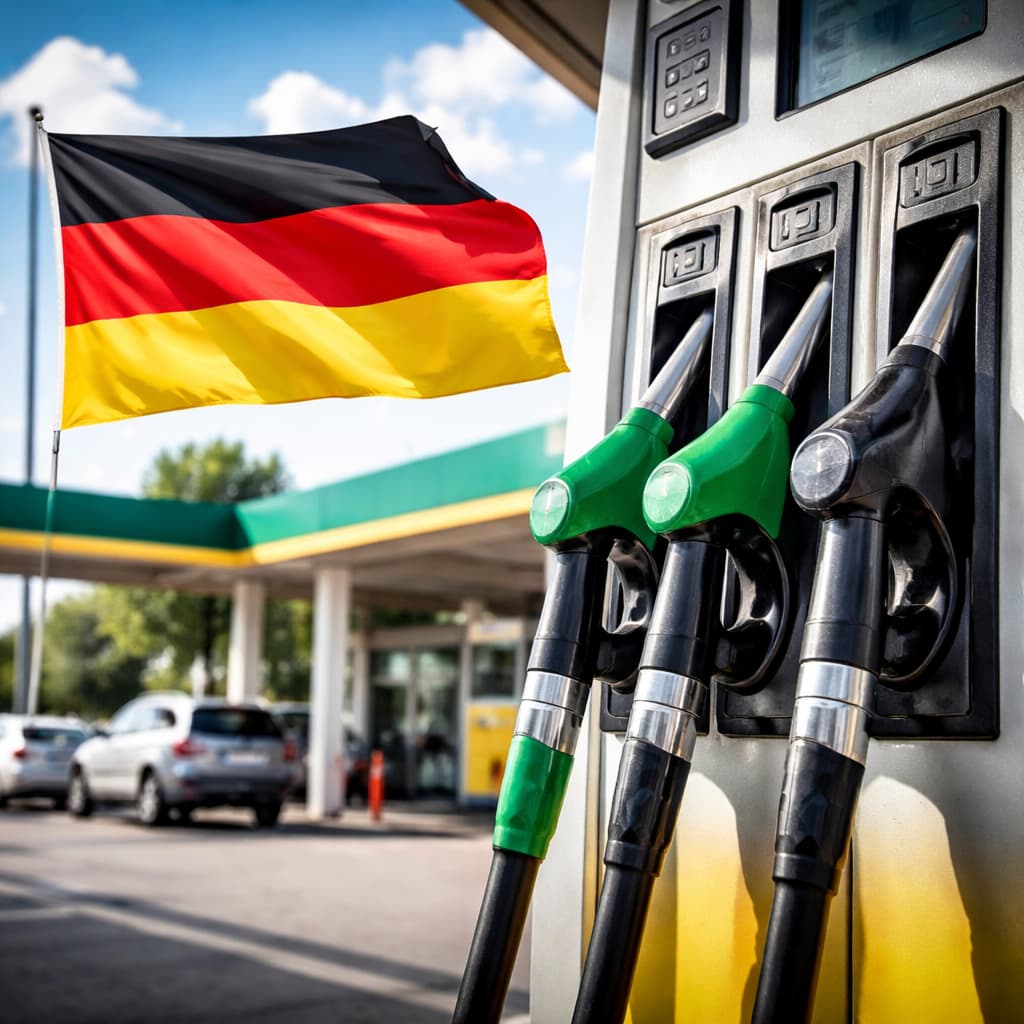
Since 1 April 2026, Germany and Austria have each regulated when service stations may raise their fuel prices. The principle is similar, but the rules differ: in Germany, only one increase per day is allowed, at noon; in Austria, increases are limited to three days a week and come with a cap on margins.
Germany: a single price increase per day, at 12:00
The rule stems from the Fuel Price Adjustment Act, the Kraftstoffpreisanpassungsgesetz (KPAnG), which came into force on 1 April 2026. According to the Bundeskartellamt, fuel prices at stations may only be raised once a day, at 12:00 noon. Price cuts remain possible at any time, with no limit on their number. A price displayed in the morning therefore cannot be raised before noon, unless the rule is broken.
We covered the bill in our article on fuel price controls in Germany (in French).
Who monitors the noon rule in Germany?
Monitoring relies on the Markttransparenzstelle für Kraftstoffe (MTS-K), attached to the Bundeskartellamt. It automatically checks compliance with the rule, records every deviation and passes the data on to the competent authorities of the federal states (Länder). The Bundeskartellamt is not responsible for enforcing the rule: it is the Länder that assess whether a deviation is an offence.
The Länder authorities can impose a fine of up to 100,000 euros. At the date of the Bundeskartellamt page, eight Länder had designated their competent authorities: Bavaria, Berlin, Hamburg, Mecklenburg-Western Pomerania, Lower Saxony, Saarland, Saxony and Schleswig-Holstein. The first data packages were sent in mid-June 2026.
The figures reported by the Bundeskartellamt
- Around 315,000 price changes per day, for three fuels (E5, E10 and diesel);
- Around 15,000 stations in Germany;
- Nearly 90% of the deviations recorded fall between 11:50 and 12:10.
The Bundeskartellamt states that many of these deviations appear to be technical errors at the start of implementation, but that some are significant. The law does not explicitly regulate price increases during closing hours: the question is left to the interpretation of the Länder authorities, and the MTS-K records these changes in any case. Finally, discrepancies between the pump price and the price shown on the sign may constitute an offence under the price indication ordinance (PAngV), again a matter for the Länder.
Austria: the fuel price brake since 1 April 2026
In Austria, the scheme is called the Spritpreisbremse. It came into force on 1 April 2026, with the publication of the ordinance. It is based on section 5aa of the Prices Act (Preisgesetz), which expires on 30 December 2026.
This provision allows prices to be limited when Austrian net fuel prices, published in the European Commission's Oil Bulletin, are at least 30% higher than two months earlier. According to E-Control, the bulletin of 26 March 2026 showed €0.92 net (€1.84 gross) for Super and €1.215 net (€2.11 gross) for diesel, compared with €0.693 and €0.783 in January.
A different rule: price increases on three days a week
Unlike Germany, the Austrian text does not provide for a single increase per day. Price increases are only allowed on Mondays, Wednesdays and Fridays, with slight deviations tolerated. E-Control specifies, however, that it analyses the increases made at 12:00 as part of its checks.
The scheme applies to diesel (B7) and Euro-Super (E10). It covers fuel sellers supplying stations, as well as station operators and registered consignees importing from another member state, but only if they belong to a vertically integrated group, or if they buy from such a group and operate at least 30 stations. Stations located on motorways are excluded.
The margin cap in Austria
A daily price limit is set relative to the previous day's wholesale quotation. On 2 April, the gap between the quotation and the selling price had to be reduced by 5 cents per litre (net). After that, the limit follows changes in the quotation: if it rises or falls by 2 cents, the cap moves by the same amount.
Each station sets its prices freely, provided it stays below its individual cap, and it is not obliged to pass on price cuts if it is already below it. E-Control stresses that the decrease is therefore not visible everywhere, because some stations were already close to the cap.
Checks and penalties in Austria
Monitoring takes place in two stages: producers and tax warehouses declare their starting values and then, every day, their expected average prices and calculation bases; stations send their prices via the Spritpreisrechner. E-Control then analyses the 12:00 increases and the average prices. In the event of repeated irregularities, an in-depth examination of the operator may be opened, with a lower threshold for station chains.
Exceeding the price limit is an administrative offence, penalised by the district administrative authorities: up to €7,265 for a first offence and €14,535 for a repeat offence.
Prices recorded in both countries
According to the European Commission's oil bulletin that we publish on our Europe fuel prices page, updated on 16 November 2026, diesel stands at €2.215/L in Germany and €2.035/L in Austria, a gap of 18 cents. For SP95 petrol, prices are €2.030/L in Germany and €1.607/L in Austria, a gap of 42.3 cents.
These gaps measure the difference between two markets, not the effect of the rules described above: taxation and other national measures also differ from one country to the other.