
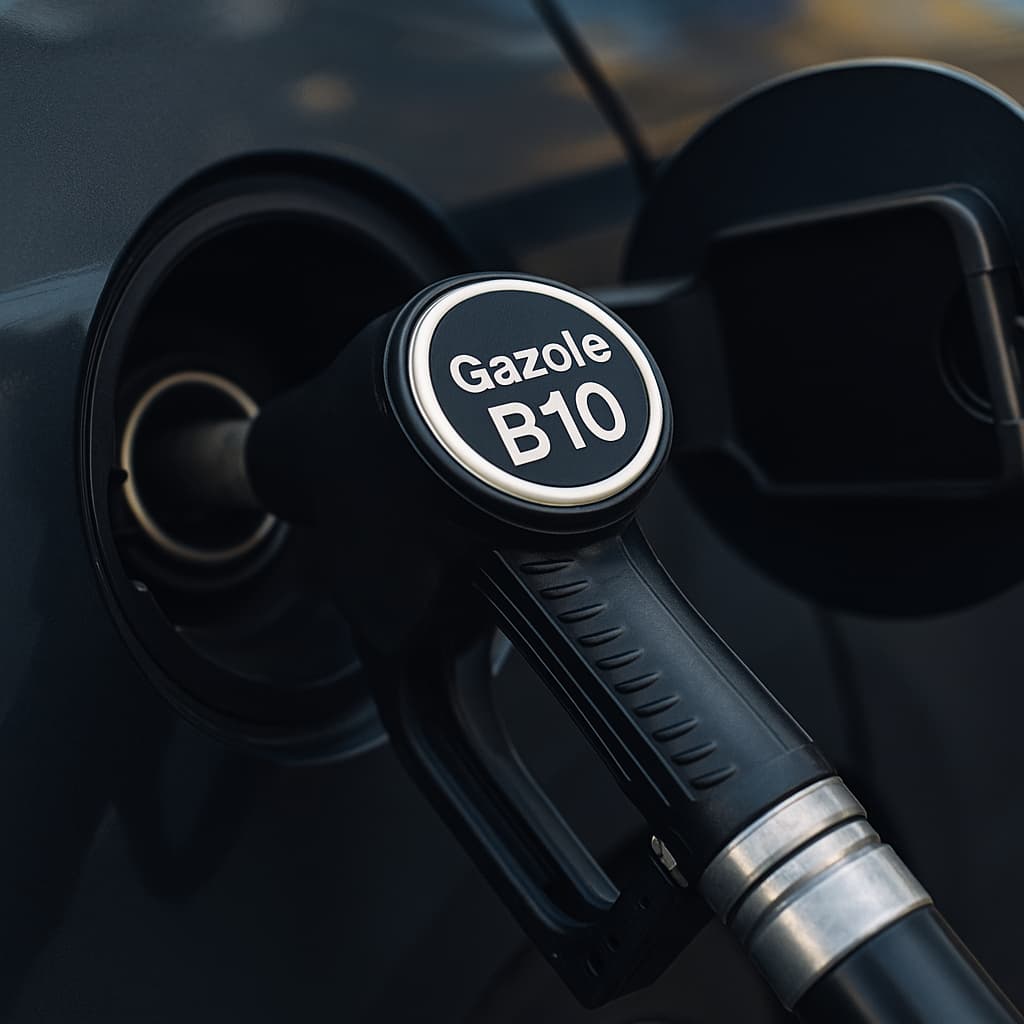
What is Diesel B10?
Diesel B10 is a diesel blend enriched with biofuels. Introduced in response to Europe’s CO₂-reduction targets, it contains up to 10% biofuel from renewable sources. This fuel fits into a broader decarbonisation strategy for road transport while remaining compatible with part of today’s diesel fleet.
What is Diesel B10 made of?
Conventional diesel (often called Diesel B7) contains up to 7% biodiesel, typically in the form of FAME (fatty acid methyl esters). As its name suggests, B10 contains up to 10%. These biocomponents are mainly produced from:
- vegetable oils (rapeseed, soybean),
- recycled used cooking oils,
- and sometimes animal fats.
This higher share reduces fossil energy use by introducing renewable feedstocks into the production chain.
Why was B10 developed?
The energy transition requires a gradual reduction in the transport sector’s carbon footprint. Diesel B10 addresses this through several advantages:
- Lower CO₂ emissions: on average, a 2–3% reduction in greenhouse-gas emissions per litre compared with B7.
- Support for agricultural value chains: notably European rapeseed.
- Immediate use: in compatible vehicles, with no technical modification.
It helps fuel retailers and public authorities meet EU targets set by the RED II (Renewable Energy Directive), which requires a growing share of renewables in transport.
Compatibility: can all vehicles run on B10?
No — and this is one of the main barriers to wider rollout. Diesel B10 is not compatible with every diesel engine. Some materials used in older engines, especially seals, can be affected by a higher biofuel content.
As of 2024, most passenger cars are not officially approved for B10. However:
- Some modern vans and heavy-duty trucks are approved for this fuel.
- Manufacturers such as Renault Trucks, MAN or Mercedes-Benz already approve several models for B10.
- For passenger cars, always check the owner’s manual or the manufacturer’s official website.
⚠️ Note: B10 does not replace B7 at the pump (yet). Both fuels coexist, with specific labelling (B10 sticker on the pump and nozzle).
What are the environmental benefits?
Using Diesel B10 offers several environmental upsides:
- Lower dependence on crude oil: thanks to a rising share of renewables,
- Reduced lifecycle CO₂ emissions: across production, transport and combustion,
- Fewer particulates: engines operating on biofuel blends can emit fewer pollutants, especially with a particulate filter.
These gains should be qualified: biodiesel production can entail indirect effects such as land-use change, deforestation risks or competition with food production.
Where can I find B10 in France?
In France, B10 is still rare at public stations, but some hypermarkets and dedicated networks (notably for heavy-duty vehicles) have started to offer it. Service stations must clearly indicate:
- the biofuel content (B10 label),
- any usage precautions,
- and vehicle compatibility.
To follow prices and availability of alternative fuels such as B10, see our fuel news and blog pages.
What’s next for Diesel B10?
Diesel B10 could play a transitional role for the French diesel fleet while larger-scale alternatives (electrification, hydrogen) expand. Wider rollout would require:
- approval of a larger share of passenger vehicles,
- a robust, sustainable and local biodiesel supply chain,
- and clearer communication to drivers about compatibility.
In time, B10 could become a standard for recent diesel engines, helping green part of the existing combustion fleet.
Sources: Ministère de la Transition écologique (https://www.ecologie.gouv.fr), ADEME (https://www.ademe.fr), Biofuel guides, Carmakers’ technical sheets (2024)